At the beginning of the year, I started thinking about signature dishes: the food you keep going back to over and over again, that you might pull out for the odd dinner party (pre-Great Global Upheaval), or for a just-because nice occasion. I asked this question of my siblings. What were their signature dishes? And, what did they think was mine?

It was easy enough to identify my brother’s: a gob-smackingly delicious lamb rogan josh (a spicy north Indian lamb curry). I won’t even attempt to make lamb when he’s here, and not just because I truly am terrible at cooking meat. It’s just that good.
My sister’s was a little more difficult to identify, because she’s generally a superb cook. But, we finally decided it was perhaps her chicken tinga, which used to be in heavy rotation during the summer months, and satisfied my craving for Mexican food—I’m still catching up after 7 years of worse-than-mediocre versions of the cuisine in India.

As for mine: When I’d posed this question early on in 2020, there wasn’t much I was making that, let’s be real, was truly delicious. Or substantial enough to take the weight of the “signature dish” title. Finally, though, my brother offered up two suggestions: a veggie quiche (made with a pre-made crust, which I didn’t think counted, but maybe it actually does count?), and this mushroom soup.
Soup.
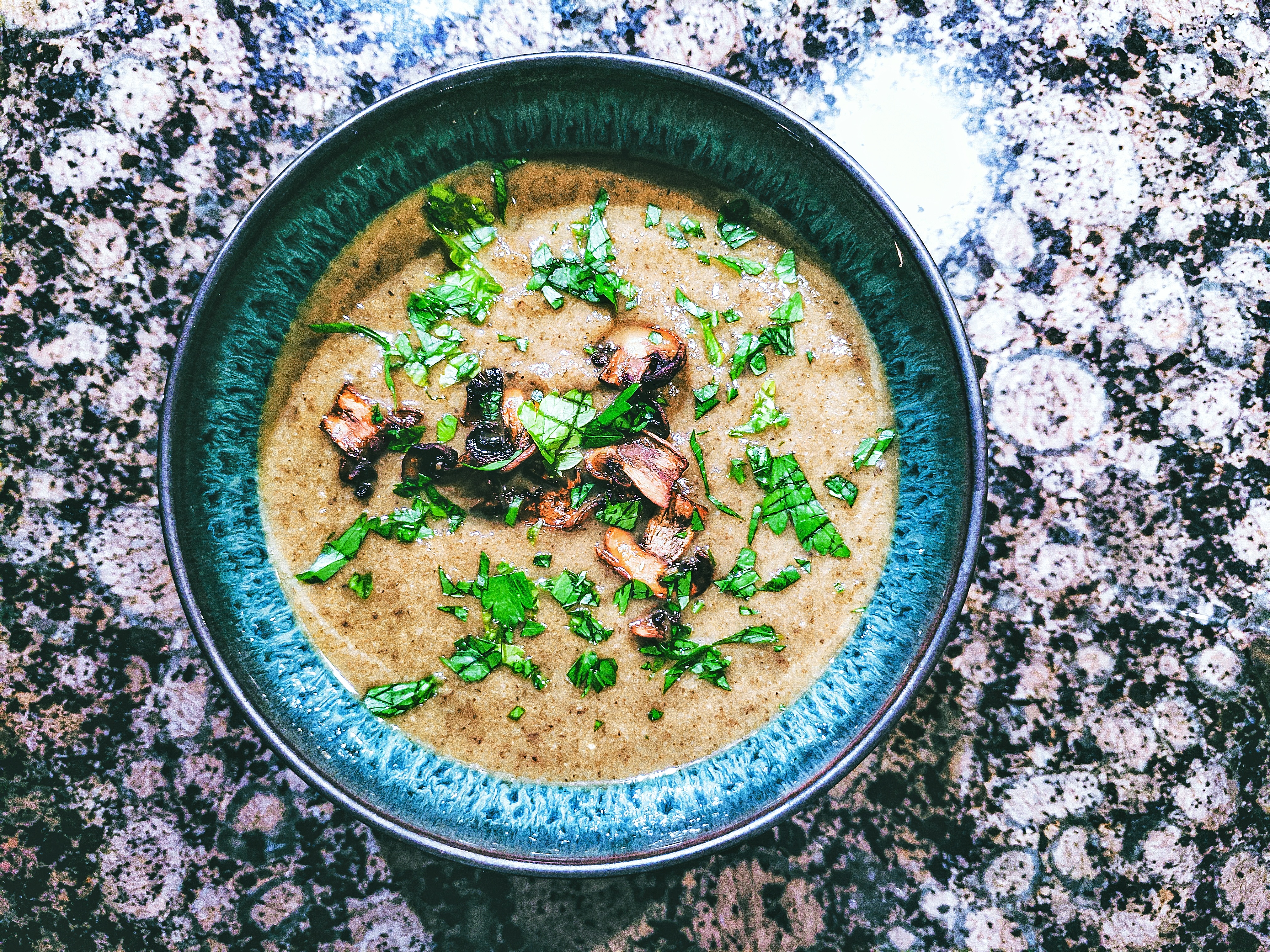
My signature dish might be liquid food.
A part of me wants to rebel against this: does soup really count as something that could be brought out at (future, post-Great Global Upheaval) dinner parties, as a main dish? It’s so often a side dish, a precursor to the main attraction. Not to mention, I wasn’t really ever a fan of soup. Growing up, it was my mom’s attempt to get me to ingest tomatoes. Which I hated. So I naturally hated it. Naturally.
So, how did I suddenly make a soup?

Major assumption here, but I think soup generally comes about because you’ve got someone sick at home, or a shit ton of fresh produce you need to finish up, fast. In my case: mushrooms. Specifically, that big box of mushrooms you get from Costco. I’d avoided mushroom soup. Because, soup. But I was tired of mushroom pasta sauce, grilled mushrooms, mushroom sabzi, mushroom fried rice. Even though I absolutely love mushrooms. I wanted more. Which meant it was, grudgingly, time for soup.
But I didn’t want cream in my soup. I didn’t want to have to go to Whole Foods to buy more mushrooms. I didn’t want to have to use sherry or white wine. Do you know how many mushroom soup recipes use sherry or white wine?? And, given I was still clinging to recipes as gospel at the time, I wanted one I could follow to the end.


So I found this recipe. With a helpful visual guide, without cream, and with optional sherry. This recipe is where I learned to slice mushrooms (and found it not therapeutic at all, unlike all the other things I’ve liked chopping). And learned about this thing called an onion-celery mix (a basic mirepoix, if you will). And learned about vegetable stocks. More on that in another post. And, basically, learned about making soup. More on that in another post too. I also learned how to properly de-leaf thyme sprigs. Wonders never cease.
And then I did the whole thing again and again, and tinkered and tinkered, because I can’t seem to resist, until I’ve made it my own and can make it in my sleep.


Which is what I’m presenting you now: A filling, comforting mushroom soup with a kick. There’s no cream, no sherry, no white wine. There are jalapeños, which sounds counter-intuitive, because mushrooms and jalapeños don’t seem to go together. But adding these peppers brings a slow-burn-like heat that keeps this from being a boring soup. I use baby bella/cremini or white button mushrooms, with and without their stems. You could also throw a mix of different (legal) ‘shrooms in there—portobellos, chanterelles, shiitakes, porcinis, those morels you foraged yourself—and it’d still be delicious. Just a bit different. Likely more complex. I’ll have to try that some time. If you do that before I do, let me know how it turns out!

This is a soup you can eat in spring—when I first made it—for those chilly but sunny days. It’s a soup that, against all odds, works in the summer, too, because of the jalapeño and fresh parsley that goes on top. It’s a soup meant for fall, which really is peak soup season. And it’s a soup for the making when you’re too depressed about darkness at 3pm in winter to cook up something fancier. At all times, though, it’s a soup that represents those warm, comforting hugs you just don’t get to experience any more in person. Thanks, Great Global Upheaval.
The secret: Fried mushrooms on top. Also, hot sauce.
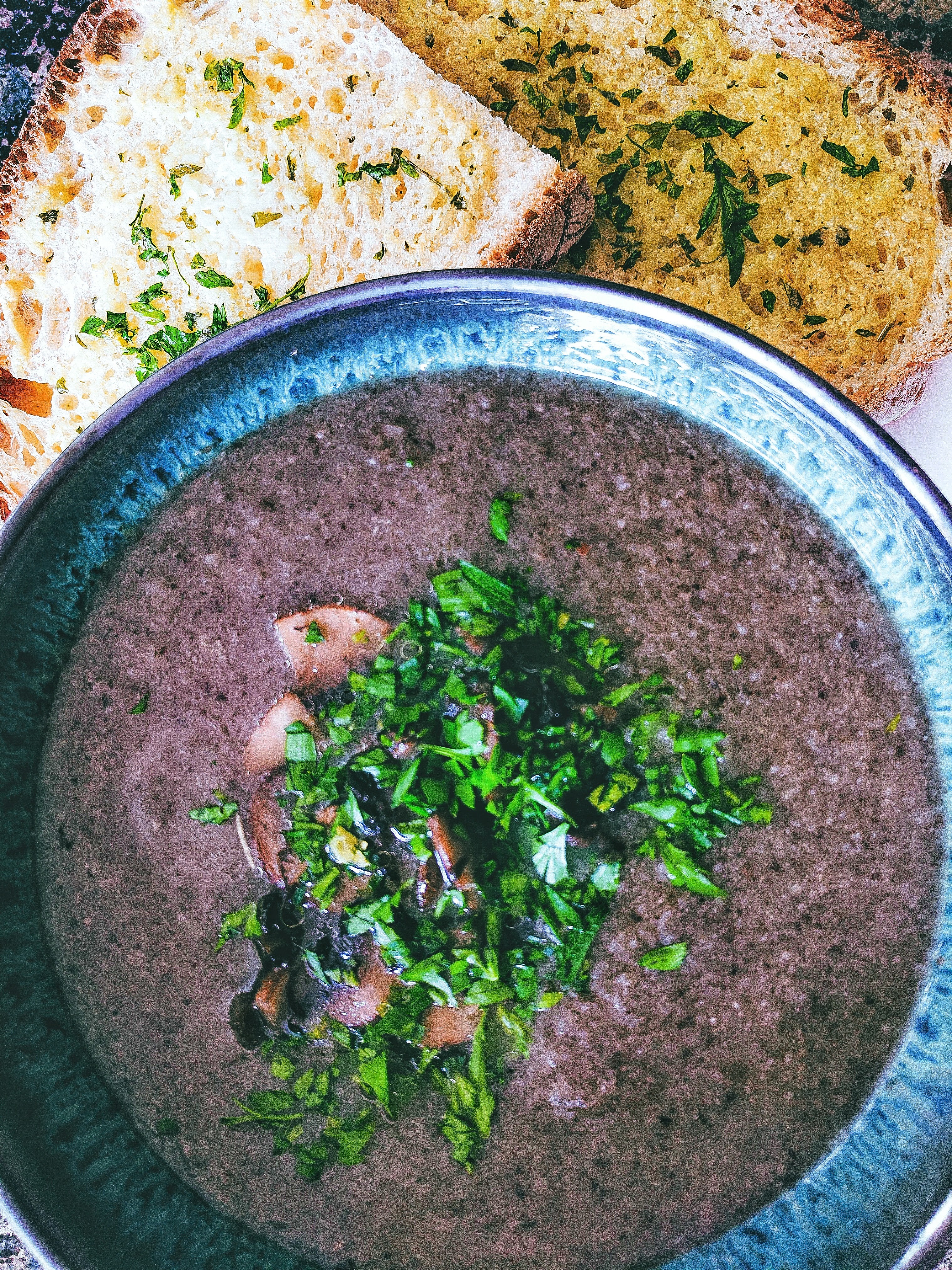

What to serve it with: A side of homemade garlic bread, or roasted/grilled veggies. If you have a bowlful-and-a-half of it though, you’ll be full up. May not even need, or want, anything else.
NON-CREAMY CREAM OF MUSHROOM SOUP WITH A KICK
Serves: 3.
Cooking time: 1 hour, because vegetables and simmering.
Ingredients
- 3-4 tbsp of a combination of your favorite cooking oil and butter (I do 2 and 2, respectively). Keep ’em separated.
- 5-6 cloves garlic, chopped (or about 2 frozen cubes of minced garlic)
- 1 medium yellow onion, chopped (1 to 1 1/2 cups)
- 3 medium stalks of celery, chopped (1 cup)
- 1/3-1/2 fresh jalapeño, deseeded and chopped (up to 1/4 cup; depends on your spice level; see note)
- 15 oz mushrooms, sliced (about 4 to 4 1/2 cups, with 1/2 cup set aside; see note)
- 3 cups of a combination of vegetable stock and water (see note)
- 3-4 sprigs of thyme, fresh or dried
- 1-2 sprigs of rosemary, fresh or dried
- Salt, to taste
- Black pepper, to taste
- Optional: parsley, chopped, to garnish
- Optional: Your favorite hot sauce (we like ghost pepper flakes or black garlic carolina reaper sauce) to garnish
Tools
- A large pot, like a Dutch oven, or a stock pot
- An immersion/stick blender or a large blender
Method
- Prep all the vegetables:
- Chop the onions and celery to similar sizes.
- The jalapeños should be chopped smaller, de-membraned, and de-seeded.
- Wash, dry, and slice the tips of the mushroom stems off (especially the tougher parts), and then chop the mushrooms up however you like. I like to slice them—thinly if I have time to kill, roughly if I don’t have the patience.
- Chop the parsley if you’re using it at the end.
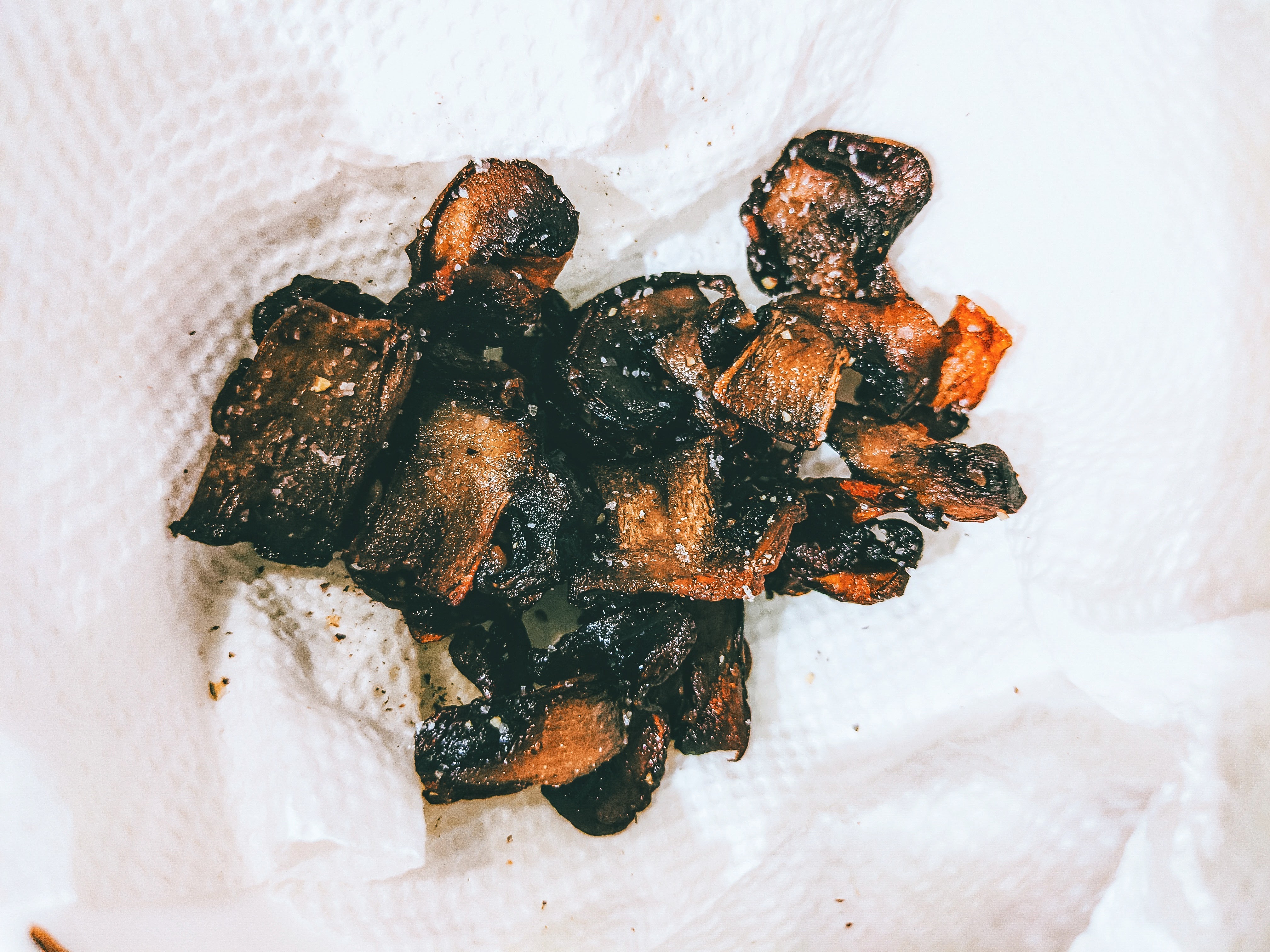
- Heat up your large pot on medium-high. Add 1tbsp of the oil (or butter), let it shimmer, then fry 1/2 cup of the sliced mushrooms (I choose the thinnest slices, generally) until they’re golden brown and crispy. Keep stirring to make sure they don’t stick to the bottom of the pot or start to go burnt-dark. Scoop them out onto a paper towel-covered surface to absorb some of the grease, and sprinkle with some salt and pepper. Set aside.
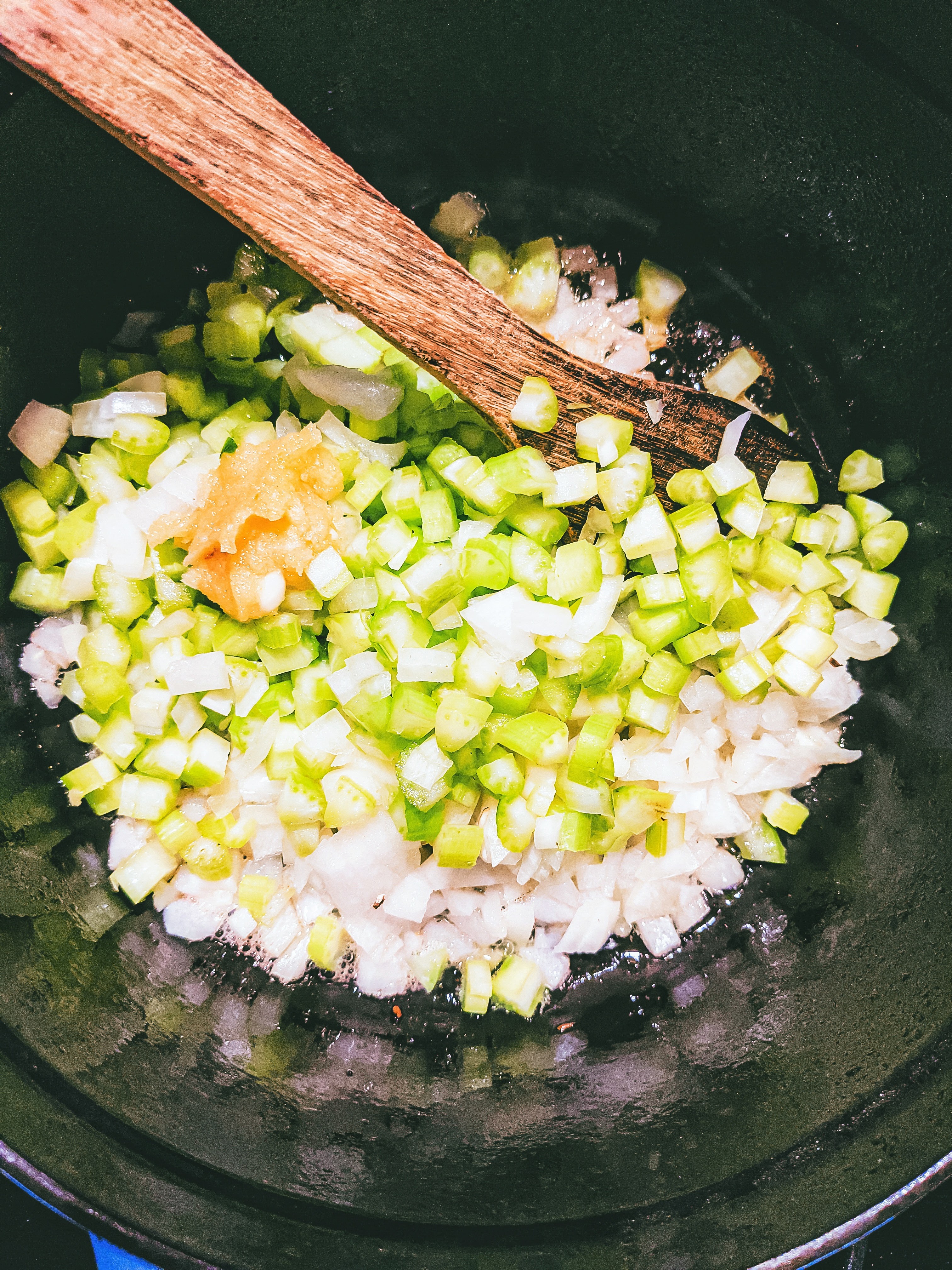
- Turn back to the pot, and add the remaining oil (or butter), keeping at medium-high heat. Dump in all the garlic, onions, and celery, and cook, stirring occasionally. This means until they begin to brown a bit. You’re not burning them, though. This may take about 10 minutes. Mix in a small pinch of salt.
- Time to add all the jalapeños and mushrooms, and a few cranks of black pepper. Cook down until the mushrooms have lost a good bit of their liquid and are turning dark and softening. Again, don’t let them burn. Keep stirring so everything gets evenly cooked against the bottom of the pan. This should take no more than 10 minutes. Again, mix in a small pinch of salt.
- Pour in the stock/water, crank up the heat to high, and let it get to boiling. While the temperature’s building up and it’s starting to foam around the edges (I love watching this energy reaction), toss in the thyme sprigs and rosemary, and, again, a tiny bit of salt.
- Once it’s boiling, drop the heat down to medium and let the whole pot simmer for a good long while (ie, at least 10 minutes, but no more than 30). You’re not touching the pot while it’s doing its thing, so this is as good a time as any to do… anything else. Staring at the pot, from personal experience, will not make it cook any faster. Sorry not sorry.
- Once you’ve simmered as long as you want, turn the heat off, and let the pot cool a bit. Blenders don’t like hot liquid, and your skin will thank you too. I usually wait around 5 minutes. Fish out the thyme and rosemary stems with a fork or spoon.
- If you’ve got a stick blender, go ahead and pulverize the soup right there in the pot. If you’re using a regular blender, blend in batches, because it definitely won’t all fit in at one go, then put it back in the pot. The goal here is to get to a smooth consistency.
- Turn the heat back on, on low, and do a taste test while the soup’s warming up again. Add salt and pepper if needed. Scalding hot is a key soup trait, after all.
- When you’re ready to eat, ladle a portion out into your bowl, and garnish with those fried mushrooms you set aside in the beginning, parsley, black pepper, and the hot sauce/flakes of your choosing. Enjoy being warm.
Notes
- On mushrooms: If you’re anti-mushroom stems in cooking, remove and store them in a scrap bag for the veggie stock you’re going to want to make, because it’s simply healthier and more environmentally friendly than buying from the store.
- On the onion and celery cook time: I don’t like burnt things—it’s all carbon ash in my mouth. I do, however, like the taste of things taken to the edge; like letting onions cook beyond soft and translucent. It’s a personal preference, and you can always stop at soft and translucent and it’ll still be a good soup.
- On vegetable stock-water: I say a combination, because I just generally do that, but go all in on the vegetable stock or the water. I’ve also used chicken stock and it’s turned out great. If you choose to use just the water, add some dried oregano or parsley flakes, for a bit of that flavor that stocks give.
- On salt: I’ve mentioned adding salt at (almost) every step. It’s an old trick that adds a depth of seasoning into every layer. If you’re wary of being too heavy-handed, just add all the salt you want in the end—well, really, when you pour in the stock.
- On the heat: Even if you have a high spice tolerance, like we do, don’t let too many seeds get into the soup, or it’ll overpower everything. I recently made that mistake, and it was… not fun. If you don’t have jalapeños but still want the heat, don’t sub in other peppers. Instead, add 1/4tsp each of red pepper flakes and black pepper to the oil/butter in Step 3, let them cook a bit, then add the onions, celery, and garlic, and proceed as usual. It’ll be a different kind of heat, but still pretty damn good.
- So you’re tasting the soup after it’s blended, and find you accidentally added too much spice: Simply turn the stove up to medium-high, add 1/2 cup water, and stir everything up to the same temperature. Add some salt and pepper (because water dilutes everything), taste again, and go from there. Your soup will be thinner, but it’ll still be good.
- On seasoning: The beauty of soups is that you can do whatever the hell you want with them (how else do you think I got to adding jalapeño?). I tend not to stray from the recipe above, because I’m simply not tempted to try anything else. But, we also recently added white pepper and fresh nutmeg to our pantry, so those might get sprinkled in. If you’ve got a spice you’re tempted to try, have at it. Go wild. Enjoy the ride. And if you taste test it and it’s terrible, dump some water in to dilute your soup, and add something else to balance it out.
- On storing: This soup will keep for up to a week in the fridge, or in the freezer for a few months. In airtight containers, of course. Because it doesn’t have any alcohol or cream in it, it won’t look or smell unappetizing and off-putting when you take it out for leftovers, either. That’s a win in my books.
 pass the pepper